I Built This Website in 3 Days for ₹2,999 — Full Build-Log
The site you are reading this on went from "domain purchased" to "live with an admin panel" between 27 and 29 August 2026. Total cash spent: ₹2,999. Total hours: about 21. I don't write code. Here is exactly what happened, including the bugs the AI missed and the mistake I made.

Rahul Purohit
· updated · 8 min read
The website you are reading right now was built between 27 and 29 August 2026. Not the design mockup, not the "coming soon" page — the whole thing: the public site, the article editor, the analytics dashboard, scheduled publishing, the lot.
Cash spent: ₹2,999. Hours logged: about 21. Lines of code typed by me: zero.
I run preschools and a small custom-software business in a small town in Pune district. I dropped out of a BCA degree in the final semester. I can read code roughly the way you can read a French menu — I recognise words, I can't write a sentence. Everything below was built by AI coding tools, with me sitting next to them as the person who decides, tests, and says "no, that's wrong".
This is a build-log, not a tutorial. I'm writing down what actually happened, in order, with the numbers.
The bill: ₹2,999, and where the zeros come from
Item | What I used | Cost |
|---|---|---|
Domain (buildkarohq.com, 3 years) | Hostinger | ₹2,999 |
Hosting + SSL + CDN | Vercel, Hobby plan | ₹0 |
Database (Postgres) | Neon, free tier | ₹0 |
Image storage | Vercel Blob, free tier | ₹0 |
Analytics + search data | Google Analytics 4 + Search Console | ₹0 |
Fonts, icons | Open-source, self-hosted | ₹0 |
Total cash | ₹2,999 |
One honest line, because the title is doing a lot of work: I already pay for AI coding tools for my client software work — roughly ₹5,000 a month. That bill exists whether or not this website does, so I haven't counted it here. If you're starting from zero, add that. It's still not ₹5 lakh.
What "the website" actually means
When people say "I built a website in a weekend," they usually mean they picked a template and changed the text. That's not this.
What went live on 29 August:
Public site: homepage, blog listing, article pages with table of contents and author box, four category hubs, About, Work With Me, Contact, Newsletter, 404 page
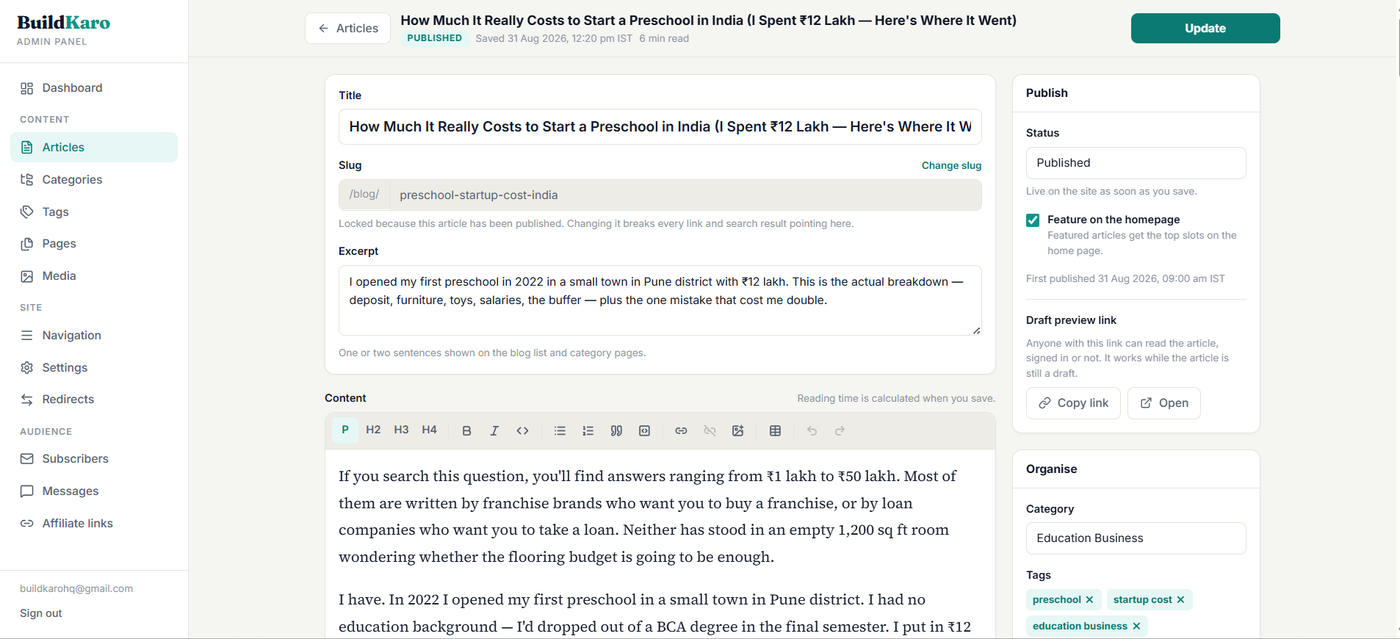
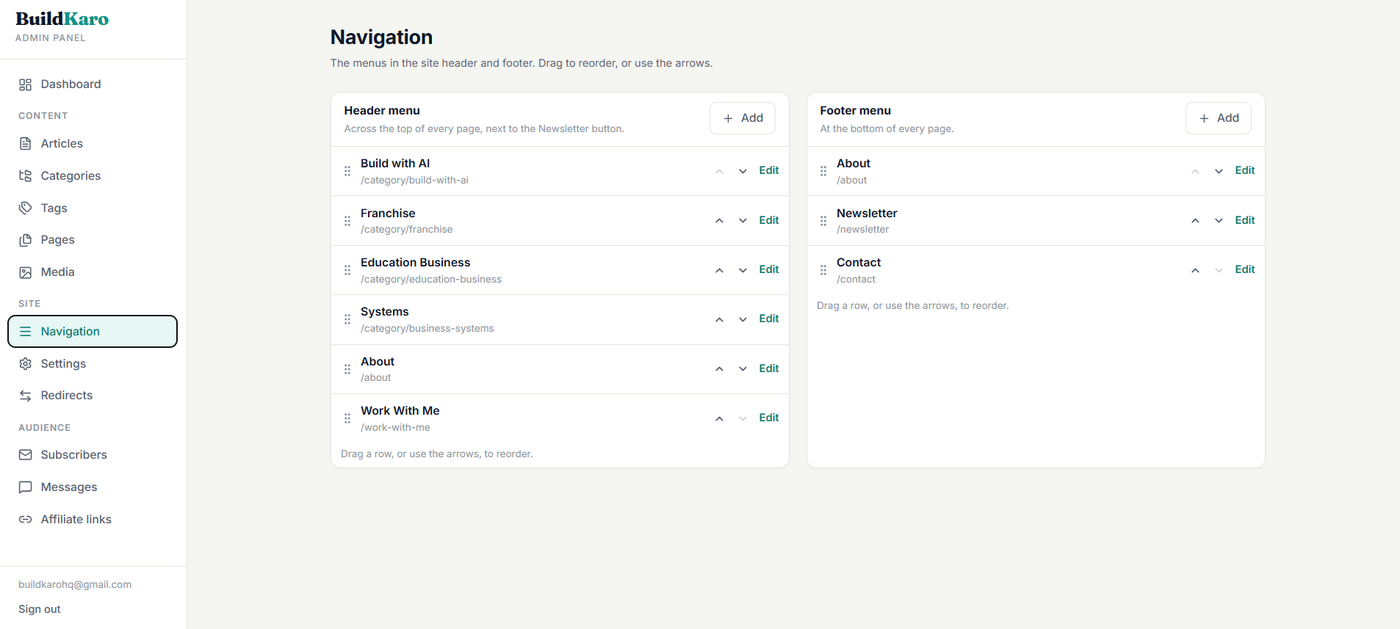
Admin panel with 12 modules: Articles, Categories, Tags, Pages, Media, Navigation, Settings, Redirects, Affiliate links, Subscribers, Messages, and a Dashboard
Article editor with headings, tables, images with left/right/centre alignment, a link panel that lists my other articles, and an SEO panel with title/description counters
Scheduled publishing — I set a date and time, walk away, and a job publishes it
SEO plumbing — sitemap, RSS feed, structured data, redirects when a slug changes
Newsletter capture — stores subscribers in my own database, with a honeypot for bots
Everything I do day-to-day on this site — write, upload images, schedule, check traffic — happens inside that admin panel. I have not touched code since launch.
Day by day
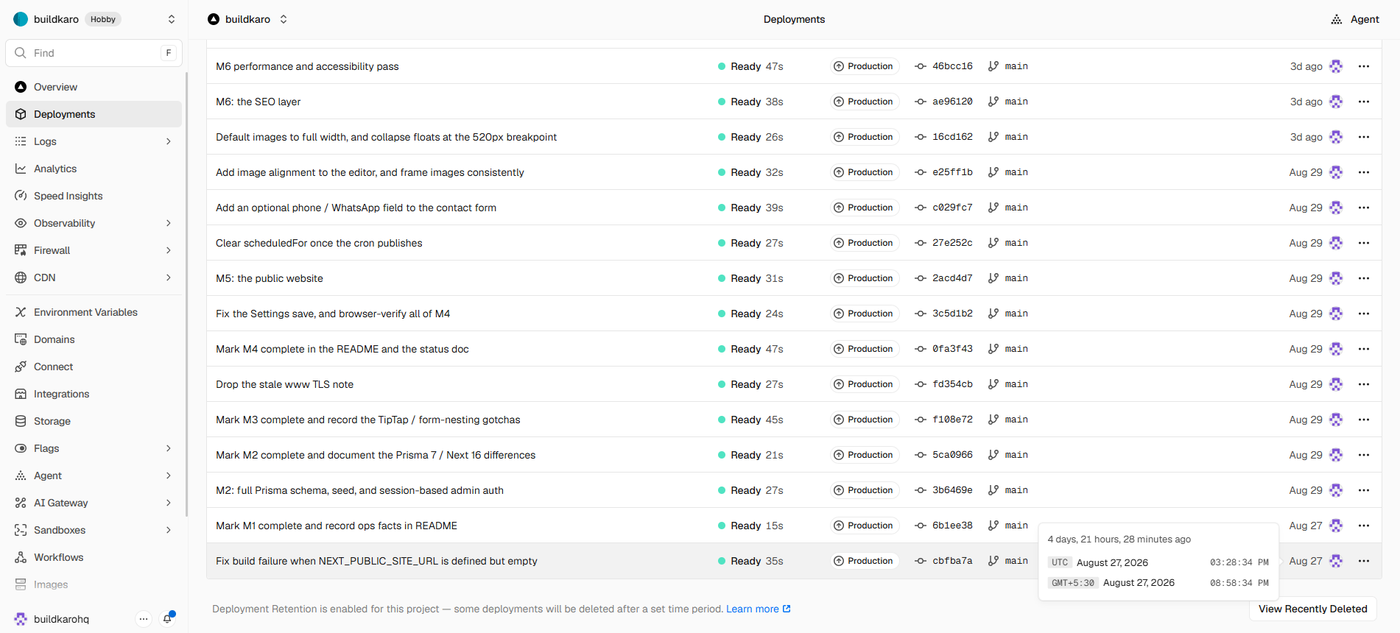
I keep the plan in a single document that the AI tools read before every session. It splits the build into milestones — M1 to M7 — and the rule is: one milestone at a time, I check it in the browser, only then move on. The deployment history on Vercel is the honest record of what happened when.
27 August — skeleton and domain (evening)
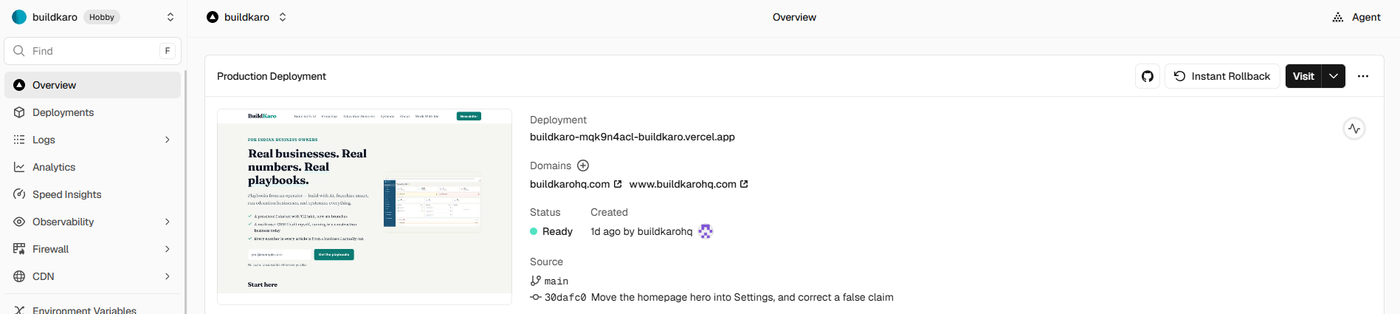
Bought the domain in the morning. By 8:58 PM the first working deploy was live on buildkarohq.com with SSL: a "coming soon" page, the project connected to GitHub and Vercel, database connected. That was M1. Around 3 hours.
28 August — zero code
Not a single deploy. I spent the day on two things: the design (five rounds of mockups — which fonts, which accent colour, light or soft background) and the content plan (which articles, in which order, for the next 90 days). This is the day people skip, and it's the day that decides whether the site looks like a template.
29 August — the whole thing
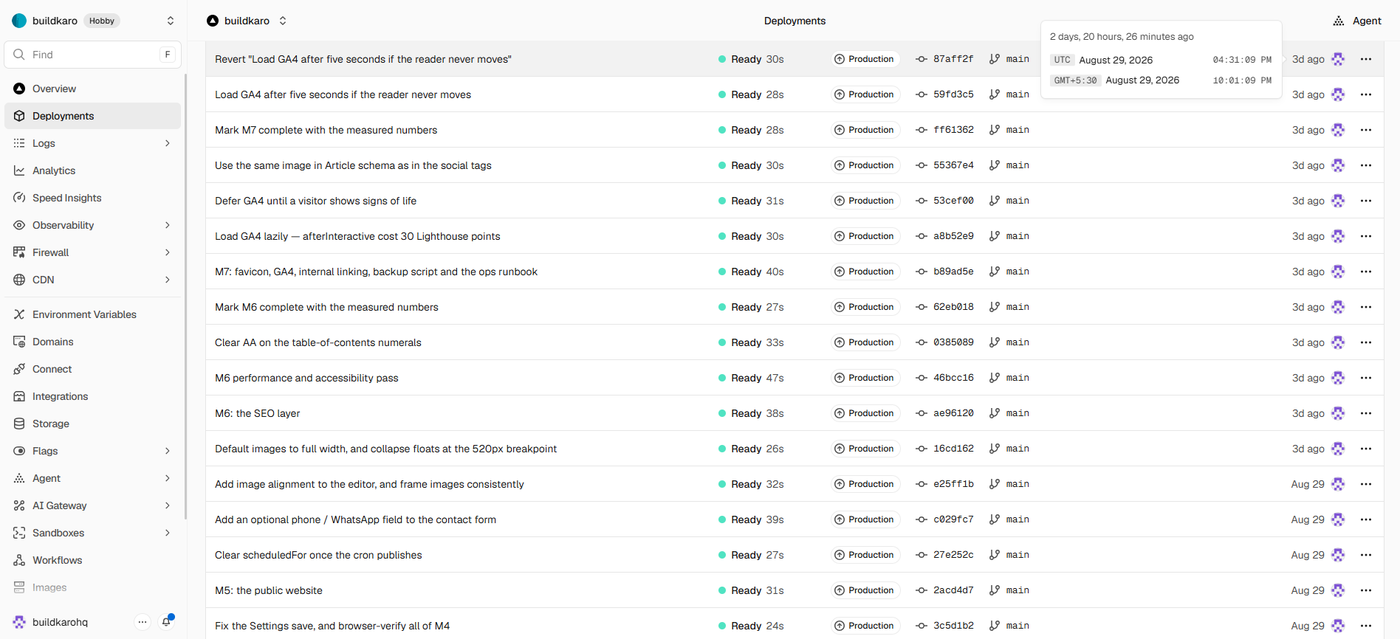
M2 (database + admin login) went live in the morning. Then M3 (article editor), M4 (the other admin modules), M5 (public site), M6 (SEO layer), M7 (analytics tag, favicon, backup script). Last deploy: 10:01 PM.
The deployment list from that day tells the story better than I can. Two lines I'll point at:
"Load GA4 lazily — afterInteractive cost 30 Lighthouse points"
"Revert: Load GA4 after five seconds if the reader never moves"
That's the analytics tag being added, tanking the performance score by 30 points, being rewritten, then partially reverted — all in about ninety minutes. I didn't write any of it. I ran the speed test, saw the score drop by 30 points, and said "that's not acceptable, fix it."
30–31 August — after launch
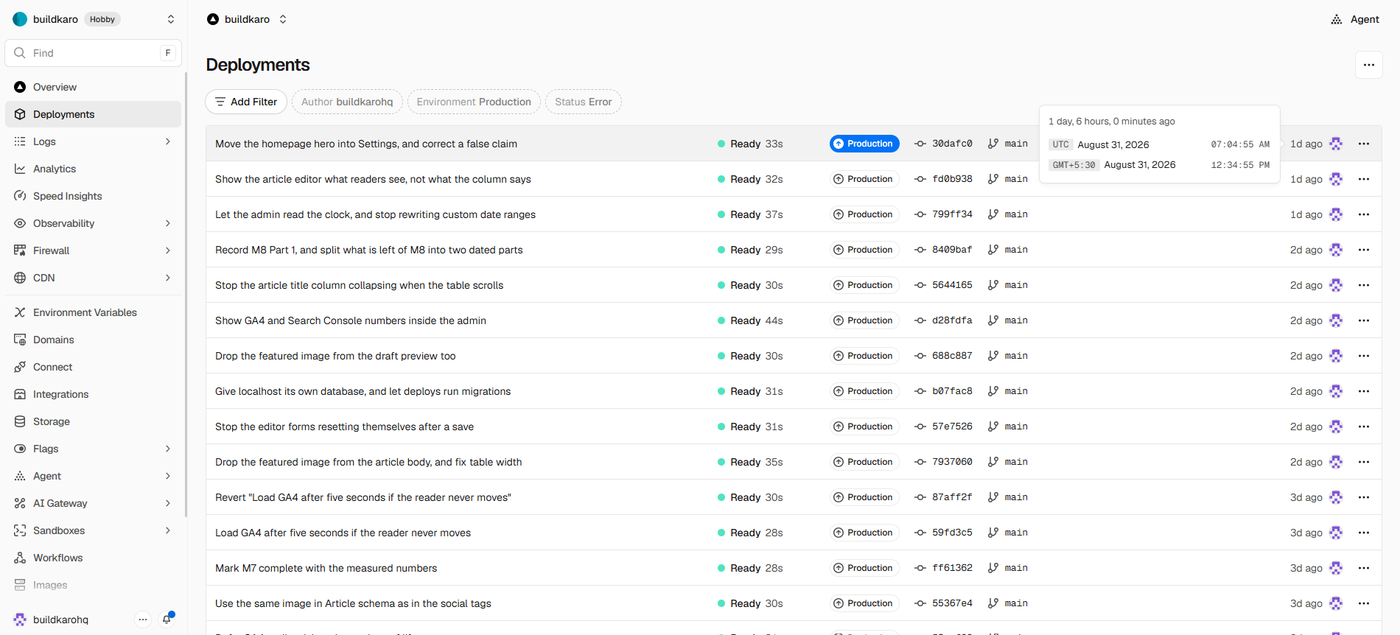
I'm not going to pretend it was done at 10:01 PM on the 29th. The next two days had deploys too: the analytics dashboard inside the admin, a fix for editor forms resetting after save, and one fix I'll come back to below because it was my fault. The first article went live on 31 August at 9:00 AM, as scheduled.
So: launch-ready in 3 days, then 2 more days of polish while I wrote the first article. Both things are true.
Why I never considered WordPress
Honest answer: I didn't think about it.
I build software for clients. In my head, a website is just another software project — a database, some screens, some rules. Starting from a WordPress theme would have meant learning someone else's system, then fighting it every time I wanted something it didn't do. Starting from nothing meant every screen in that admin panel does exactly what I asked and nothing else.
That's an opinion, not advice. If you don't build software and you just need a blog, WordPress will get you there faster than this did. But you'll pay for hosting, you'll pay for a theme, and you'll spend your evenings looking for plugins.
The three bugs the AI didn't catch
This is the part I'd want someone to tell me before I started.
In the editor build (M3), three bugs shipped that the AI tools said were done and tested:
The nested form. Pressing Enter in the title field logged me out of the admin. The article form was sitting inside the sign-out form, so Enter submitted the wrong one.
The image race. Upload an image and hit save quickly, and the article saved without it — the save finished before the upload did.
The slug drift. Editing a published article's title quietly changed its URL, which would have broken every link and Google result pointing to it.
None of these showed up in the automated checks. I found all three by clicking around in the browser like a normal person. That's my warning to any non-coder doing this: the AI does not test the way you use the thing. If you don't sit there and try to break it, the bug goes live and your readers find it for you.
The fix in all three cases took minutes once I described what I saw. Finding them was the work.
My mistake: one database for testing and live
For the first three days, my laptop and the live site were talking to the same database.
I knew this was a risk — it's written in my own planning doc as "do this before M5." I didn't. So every test article I created while checking the editor sat in the live database — on a site that was already public — until I deleted them by hand. Worse, if a test had gone wrong, it could have wrecked the real content.
Fixed on 30 August ("Give localhost its own database"). Free — Neon lets you branch the database. Cost me nothing except the embarrassment of knowing better and skipping it because I was in a hurry.
The numbers, three days after launch
I want to show the real dashboard, not a fake one.
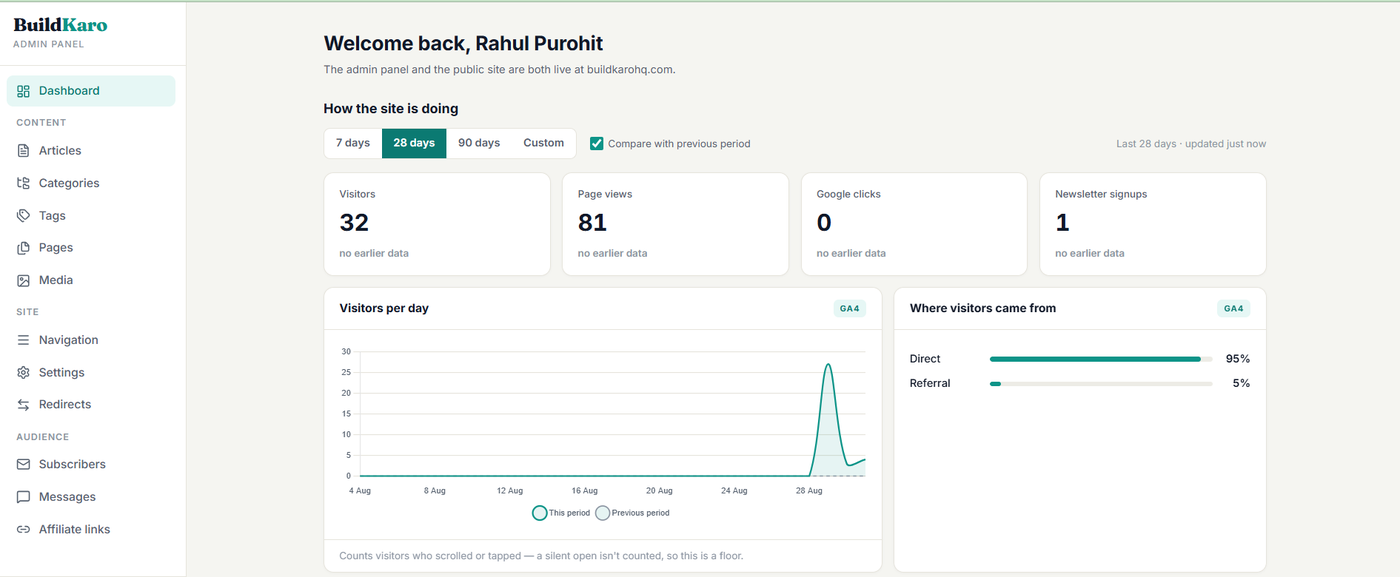
Visitors since 29 Aug: 32
Page views: 81
Newsletter signups: 1
Google clicks: 0 — Search Console takes a few days to start reporting, and the sitemap was submitted on the 29th
That 32 is the number of people who scrolled or tapped. The analytics tag only loads when a reader does something, because loading it upfront cost 30 points of speed. So the real number is a bit higher. I'd rather under-count.
And the speed score, because I made a fuss about it above:
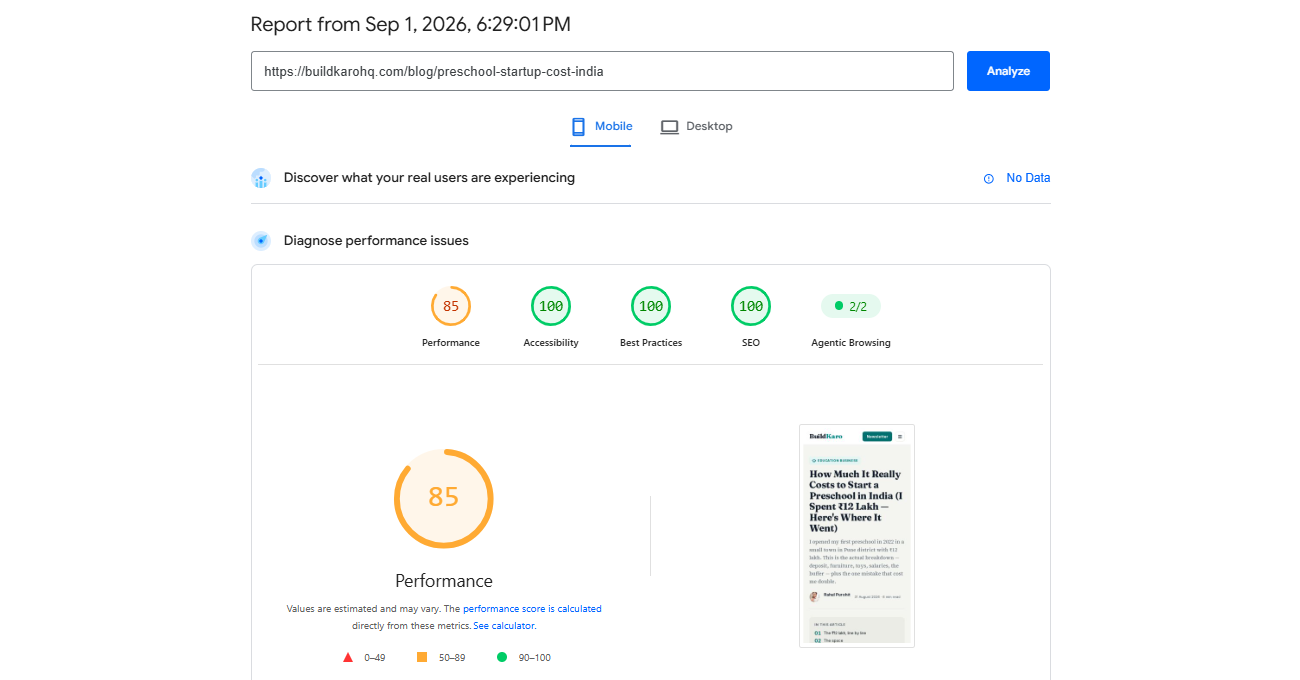
On 29 August, with no real images on the site, the article page scored 96 on mobile. Today, with a proper featured image on the first article, it's 85. The image is loading later than it should (Largest Contentful Paint at 3.8 seconds). That's on the fix list for this week. I'm publishing the 85 because that's what it is right now; I'll update this line when it's fixed.
Should you do this?
Do it if:
You already run a business and you'd rather own the tool than rent it
You are willing to sit in the browser and test everything yourself
You have a plan written down before you open the AI tool — mine was two documents and a milestone list
Don't do it if:
You need a blog by tonight and you don't care how it works underneath
You expect the AI to check its own work (it won't — see the three bugs)
"It's free" is the main reason. It's ₹2,999 plus 21 hours of your attention plus a tool subscription. That's cheap, not free.
I'll do the same kind of build-log for a client project next — a multi-user CRM for a construction company, which was the first piece of software I ever shipped this way. Different problem, same method.
