Build vs Buy: Software for Your Preschool or Coaching Class (The 2-Question Test I Use)
My branches went from Excel to software demos to an agency-built app that has run for three years. Here's the two-question test I use to decide between ready-made school software and building your own — and why price isn't one of the questions.

Rahul Purohit
· 10 min read
At least once a month, a preschool or coaching owner asks me the same question: "Which software should I take?" Usually they have a demo link from one company, a WhatsApp forward from another, and a register on the desk that is already falling apart.
I have an unfair advantage on this question, because I have sat on every side of it. My own branches have run on a register, then Excel, then a custom app we paid an agency to build. I have taken demos of ready-made school software and said no. And since February 2026, I build custom software for other businesses myself.
So this is not a list of "top 10 school ERPs". It is how I would actually make the decision if I were opening a preschool or coaching class today — and the one test I use, which has nothing to do with price.
Where my branches started: a register, then Excel (2022)
My first preschool opened in 2022. For that first year, everything lived in registers and an Excel file — admissions, fees, attendance, inquiries.
Excel did not fail on day one. It failed slowly, in three places:
Follow-ups got missed. A parent called, said "we'll visit next week", and that promise lived in one staff member's memory. If she was on leave, the inquiry simply died.
Fee reminders got missed. Parents pay in installments. Tracking who paid which installment, and who is due this week, across a sheet that three people edit — something always slipped.
Staff time went into updating, not working. Every update had to be typed in by hand, and every hand-typed update was a chance for a mistake. The more we grew, the more time went into keeping the sheet right instead of talking to parents.
None of these is dramatic on its own. Together, for a business where admissions depend on follow-ups and cash depends on installments, they are expensive.
I took demos of ready-made software. None of them fit. (2023)
By 2023, it was clear we needed real software. The obvious first move was ready-made school software — the kind you log into and pay for monthly.
I took demos. They were not bad products. They just did not fit how we worked:
The requirements did not match — our fee, admission and follow-up flow was not what the software assumed a school does.
The interface did not suit our staff, who needed something simple enough to use without training every week.
Multiple user logins — different people at different branches seeing and doing different things — did not work the way we needed.
So we got a custom app built by a software agency. It cost us a few lakh rupees upfront, plus a monthly maintenance fee of a few thousand rupees while the app was being completed. Once it was done, the maintenance stopped.
What that app does today, three years later
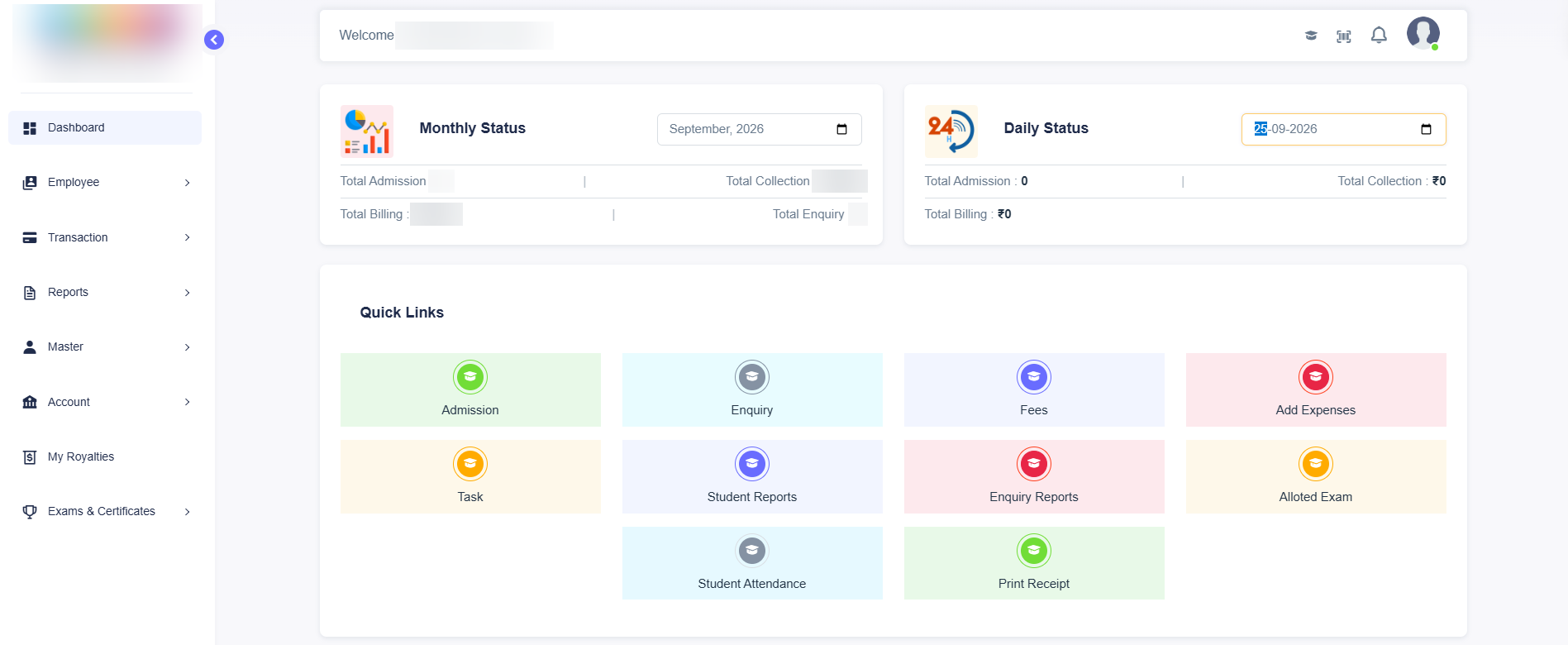
We have been running on it since 2023 and still do, in 2026. Fees, attendance, admissions, inquiries and follow-ups, receipts and reports — all in one app, with separate logins for the people who need them.
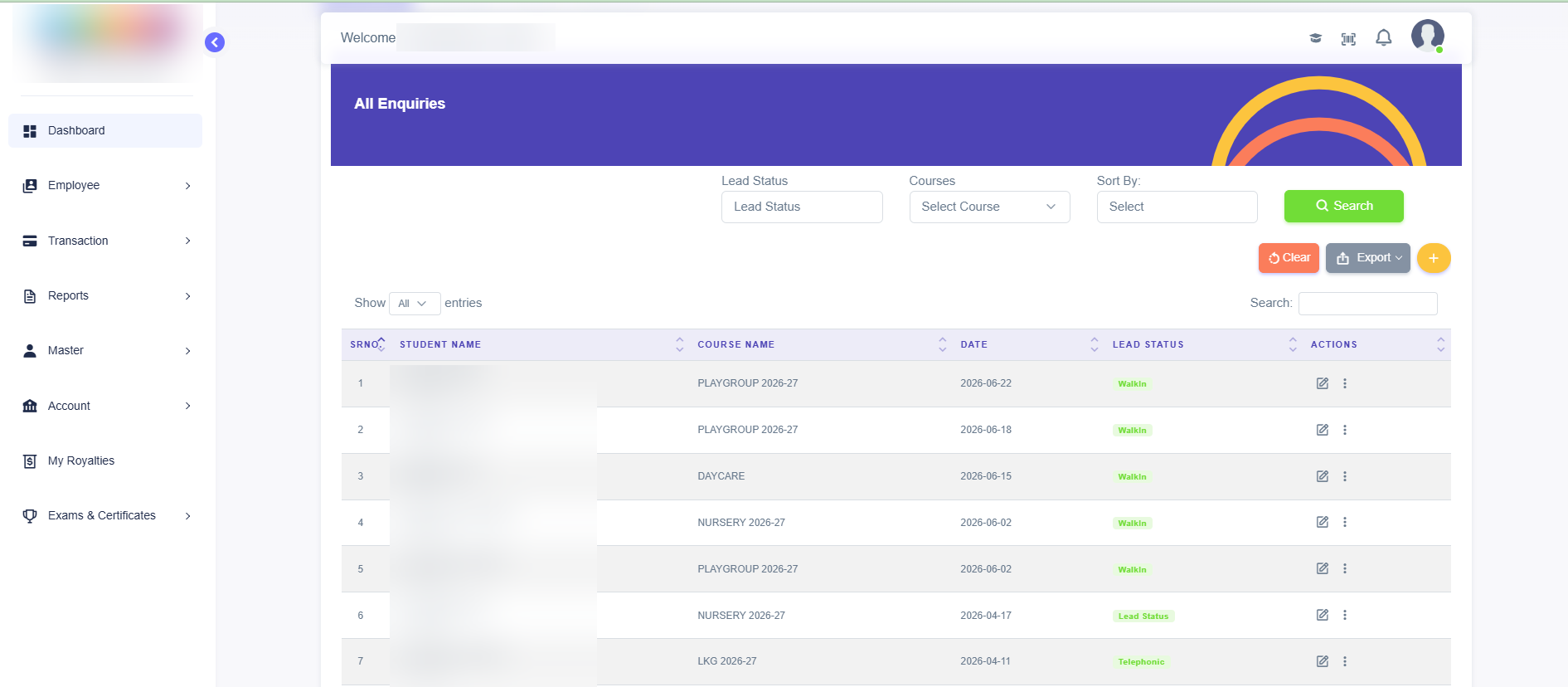
The part I use most as an owner is the inquiry list. Every inquiry is recorded with the class it is for, the date and how it came in — walk-in or phone call — so a follow-up does not depend on anyone's memory.
Since the maintenance stopped, we have made small changes now and then, nothing major. The app does what it was built to do, and it has done it for three years. That, for me, is what "worth it" looks like — not the day you buy software, but the third year you are still using it without complaining.
The three options on the table in 2026
Here is how the choice looks today for a preschool or coaching owner. The per-student price below is the general market range I see quoted for ready-made school software — I have not bought on this model myself, so read it as a market range, not my bill.
Option | What you pay | Where it fits | Where it breaks |
|---|---|---|---|
Register / Excel | Almost nothing | First year, one branch, one person keeping records | Missed follow-ups, missed fee reminders, hours of manual updates |
Ready-made software (monthly) | Market range roughly ₹10–100 per student per month | Your process is close to what the software assumes | When your process is different, or the bill grows with you |
Custom-built (agency) | A few lakh upfront (ours, 2023) + maintenance | Your process is specific and you can explain it | If nobody on your side has time to explain what you need |
Custom-built (with AI, 2026) | Thousands, not lakhs — real project prices here | Same as above, at a fraction of the cost | Same: vague requirements produce bad software, however cheap |
A quick piece of arithmetic, just to make the monthly model real: one branch of mine has about 78 students today. At ₹10–100 per student per month, that one branch alone would be roughly ₹780 to ₹7,800 a month — every month, and it rises with every admission. That is not good or bad by itself. It is just a number you should see before you sign, not after.
My test: two questions — and price is not one of them
This is the opinion I hold most strongly on this topic: don't choose software by its price. Choose it by fit. Everybody starts by comparing the monthly fee with the build cost, and that comparison decides almost nothing. These two questions decide it.
Question 1: Does something ready-made actually fulfil your requirement?
Not "does it have a fees module". Does it run your reporting, your cash flow, your business logic — the way your fees are split, the way your follow-ups happen, the way your branches report? If a ready-made product does that well and your business benefits from it, take it on a monthly basis. There is no prize for building something that already exists.
Question 2: Do you have the time to explain your business to whoever builds it?
This is the question people skip. Custom software is only as good as the explanation behind it. Whether it is an agency, a freelancer or someone like me, they need you — the owner — to sit with them and walk through how things actually work. If your profession and your business leave you no time for that, buy ready-made. A custom tool built on a half-explained requirement is worse than a ready-made one that fits 80%.
You have time to explain | You don't have time | |
|---|---|---|
Ready-made fits your requirement | Buy it. Don't build for the sake of building. | Buy it. |
Ready-made doesn't fit | Build it. This is where custom pays off. | Wait. Keep Excel disciplined until you can give it the time — then build. |
In 2023, we were in the bottom-left box: nothing ready-made fit, and I could give the agency the time. So we built. If I had been in the top row, I would have bought, and I would tell you the same.
What happens to a monthly bill as you grow
I would not call these hidden costs — they are usually written on the pricing page. But owners rarely do the maths for year three.
More users, higher bill. Most ready-made software is priced per student, per user or per login. Every new admission, every new staff member, every new branch moves the bill up.
Customisation costs extra. The moment you need a feature outside the standard package, it usually comes as a paid add-on.
I know this side well from outside education. For stock trading and options strategies, I have used a lot of ready-made software over the years. Where those tools stopped matching what I needed, I started building my own — and for the last three months I have been building a web application for traders that is itself a subscription product. So I am not against monthly software. I am building one. My only point is: know which of the two questions it answers for you.
If you do build: three things I would settle first
I have covered the ownership checks — whose name the code, hosting and domain are in — in what custom software really costs in India. Our app, for the record, is in our company's name. Beyond that, from our own experience:
Plan for multiple logins from day one. This was the exact thing ready-made software could not do for us. If you have, or plan to have, more than one branch or more than one person entering data, say so in the first meeting.
Decide who makes changes after handover. Maintenance stopping is fine — ours did. But know in advance who you will call when you need a new field or a new report, and roughly what it will cost. The market commonly quotes annual maintenance at around 15–20% of the build cost; for a small school app, the small-change route may be enough.
Write your process down before the first meeting. Admission to fee receipt, step by step. If you cannot fit it on one page, the software will not fix it. I have written about how to explain a requirement clearly — the same applies whether you build with AI yourself or hire someone.
Where AI changes the build side
In 2023, custom meant an agency and a few lakh rupees. That is the part that has changed most.
This week — 20 to 24 September 2026 — I built a reporting system for a business owner who runs several companies. It holds the records of multiple businesses in one place; his head-office team logs their assigned work and reports under their own logins; he runs his to-do list and sets meetings from the same app. It took five days, the fastest I have built anything, because it was his priority and I cleared the time for it.
That is the same category of software my branches paid lakhs for in 2023. I explain how that is possible — and what I charge — in how I build business software without being a coder. For a preschool or coaching owner, the practical meaning is simple: if ready-made software doesn't fit you, "custom" is no longer automatically out of budget.
My mistake: the cobbler's children have no shoes
There is an old saying that the cobbler's own children walk barefoot. I have become a fairly good example of it.
Since February 2026, I have built software for 11+ clients — a construction company's CRM, a clinic's management system, a website with data collection for a friend's preschool, a brochure generator for a computer institute, and now a multi-business reporting system in five days.
For my own preschool network? Our day-to-day still runs on the agency app from 2023. I started a staff-reporting tool for my own business earlier this year — it is still half-done. Every time I sat down to build something for my own branches, a client project with a deadline walked in, and the client won.
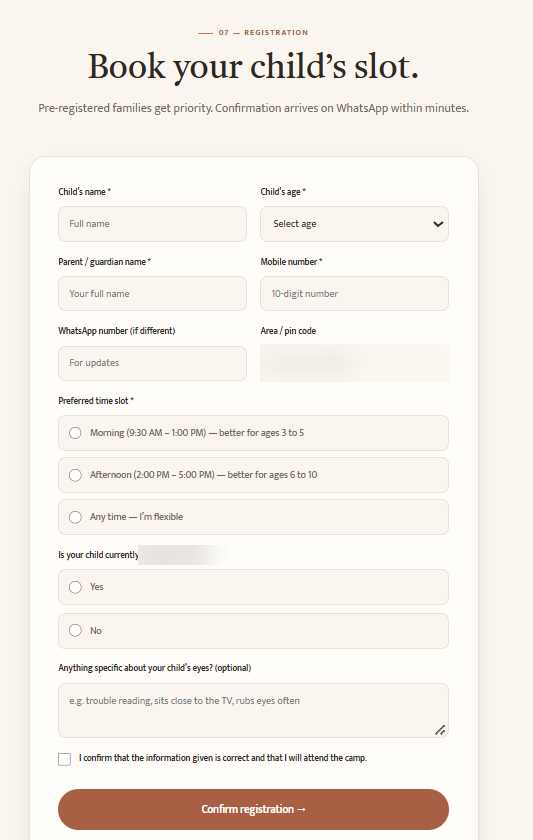
The only thing I have built for my own preschool so far is a landing page: in June 2026, we ran a free eye-checkup camp for children, and I built the registration page for it. More than 90 families registered through that page, and roughly the same number of children came for the checkup.
It is not a disaster — the agency app works, and it has worked for three years. But the joke is on me: I can build a reporting system for someone else's companies in five days, and my own branches are still waiting in the queue.
What I have learned from all this client work — how to build properly with AI, how to structure it — is exactly what my own branches will benefit from next. That queue is moving up.
So which should you pick?
If you are running your first year with one branch, a disciplined Excel sheet is fine. Fill it in daily.
When the sheet stops being enough, don't start with prices. Ask the two questions. If something ready-made fits your requirement, buy it and get back to running your school. If nothing fits and you have the time to explain your business properly, build — and in 2026, building no longer has to cost lakhs.
And if nothing fits and you have no time? Wait. The worst software is the one built for a business its owner never explained.
