How I Build Business Software Without Being a Coder (11+ Clients, Real Costs)
I first tried an AI coding tool in Feb 2026 and failed my first week. Seven months later: 11+ paying clients and real projects from ₹15,000 to ₹65,000. The honest, complete story.

Rahul Purohit
· updated · 12 min read
In the last week of February 2026, I opened an AI coding tool for the first time. My first week with it was a complete failure — nothing worked, because I didn't know how to work with it.
Seven months later, I've built and delivered software for 11+ paying clients: a multi-user CRM for a construction company, a complete management system for a clinic, a data-collection website for a preschool, a one-click brochure-design app for a computer institute. Project prices: ₹15,000 to ₹65,000. Every single client came through referral — I've never run an ad.
I still can't write code.
This article is the honest version of how that works: my background, how I got the first client, what I actually built, what I charged, what my tools cost every month, and where the limits are. If you run a small business in India and you've ever been quoted lakhs for "custom software" — or you're a non-coder wondering if you could build software yourself — this is for you.
My background: I understand businesses, not code
I'm a BCA dropout — I left in the third year. After that, I worked as a branch head at a computer training institute, where my job was management: running the branch, handling operations, understanding how the business actually functioned day to day.
If the question in your head right now is whether you could do this — what you actually need, and what you can safely ignore — I've answered that separately here: can a non-coder really build software with AI?
Software always interested me a little, but writing software was never my thing. What genuinely interested me was understanding business processes — how work flows, where it breaks, what an owner actually needs to see every day.
For years that felt like a side interest. It turned out to be the entire foundation. When AI coding tools arrived, the coding part — the part I couldn't do — became the part the tool handles. The part the tool can't do — understanding the client's business — was the part I'd been doing all along.
Week one: an honest failure
I had heard about AI coding tools for a while before I tried one. In the last week of February 2026, I finally sat down with one.
It went badly. My first interactions produced nothing useful. The tool wasn't the problem — I was. I didn't know how to describe what I wanted, how to break a project into steps, how to check what it built. I was expecting magic; what these tools actually need is a clear-thinking operator.
So I treated it like any other skill: I learned how to use it. Once I understood how to plan, instruct, and verify, the same tool that gave me nothing in week one started producing working software.
That first failed week is the most important thing I can tell a beginner. If your first few days go nowhere, that's not evidence that "non-coders can't do this." It's the normal starting point. Mine looked exactly the same.
How I got my first paying client
My first project came from watching, not pitching.
I was closely observing the operations of a construction company. One problem stood out immediately: ground-level reporting was broken. They had multiple sites running at once, and the owners had no clean way to know — which site is at which phase? What did the engineer do today? How much work is actually done?
All of that information travelled by phone calls and chasing people. It reached the owners late, incomplete, or not at all.
I understood the problem first, as a business problem. Then I did something that cost me nothing but won the project: I made small mockups — simple screens showing how their software could look and how the reporting would flow. Not a sales pitch, not a proposal document. Just: "here's your problem, and here's what the solution would look like on screen."
They said yes. A non-coder's first client doesn't come from a degree or a portfolio — it comes from showing someone you understand their business better than anyone selling them software does.
What I built: a multi-user construction CRM (₹65,000)
The software I delivered solved the reporting problem with roles:
Engineers report from the site — what work happened, at which site, in which phase.
Owners see everything, anytime — site-wise progress, phase-wise status, without calling anyone.
Client-side work in the same system — client data, follow-ups, and quotation preparation.
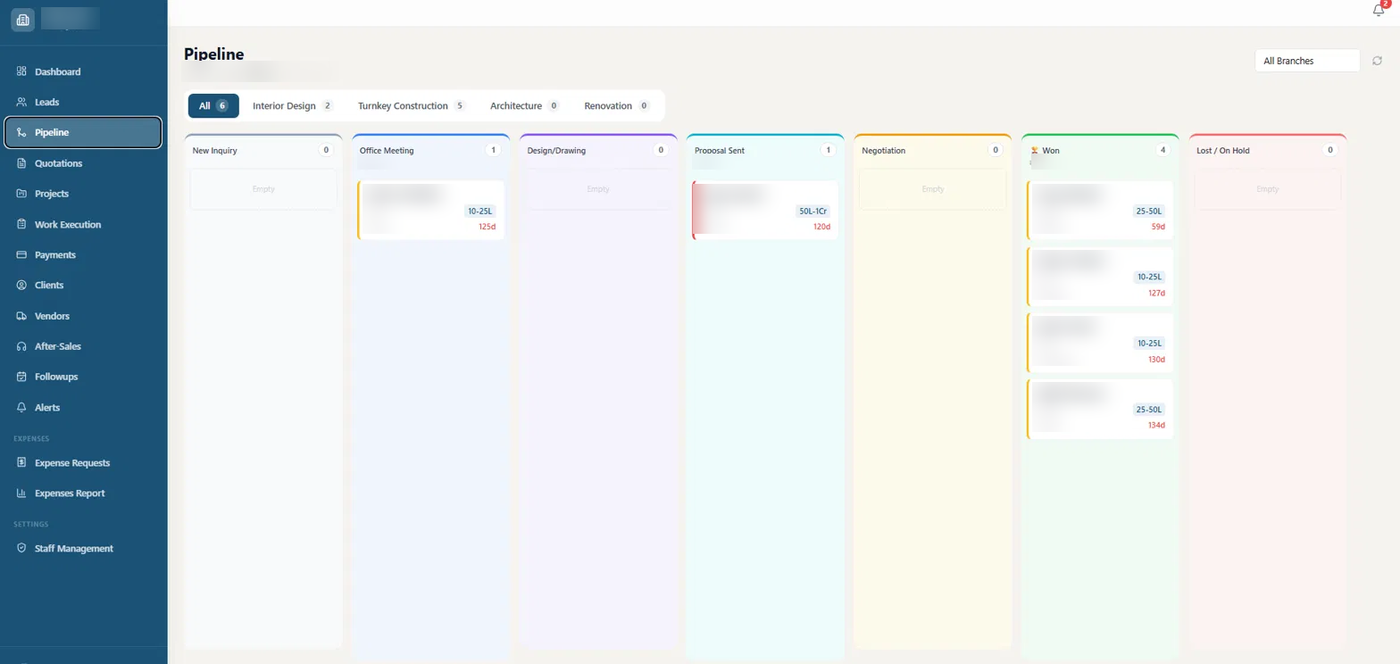
The daily chase for updates ended. The owners open the system and the ground reality is there. For this, in 2026, I charged ₹65,000.
For context: before this project, the owner had received a quotation from a software agency for the same requirement — ₹6,90,000. I delivered it for ₹65,000. The gap is real, and I break down exactly why it exists in What Custom Software Really Costs in India
I'm also writing a full build-log of this CRM project — every step, with screenshots — as its own article soon.
11+ clients in 7 months — who they are
Since that first project, the work has grown entirely through referrals. One client sees the software, tells another business owner, shows them what I built, and the next conversation starts. No digital ads, no traditional advertising, nothing. Every client so far: referral.
The businesses I've built for:
Type of business | Type of software |
|---|---|
Construction company | Multi-user CRM with site reporting and quotations |
Clinic | Complete management system — patients, appointments, prescriptions, billing |
Preschools | Websites with data collection |
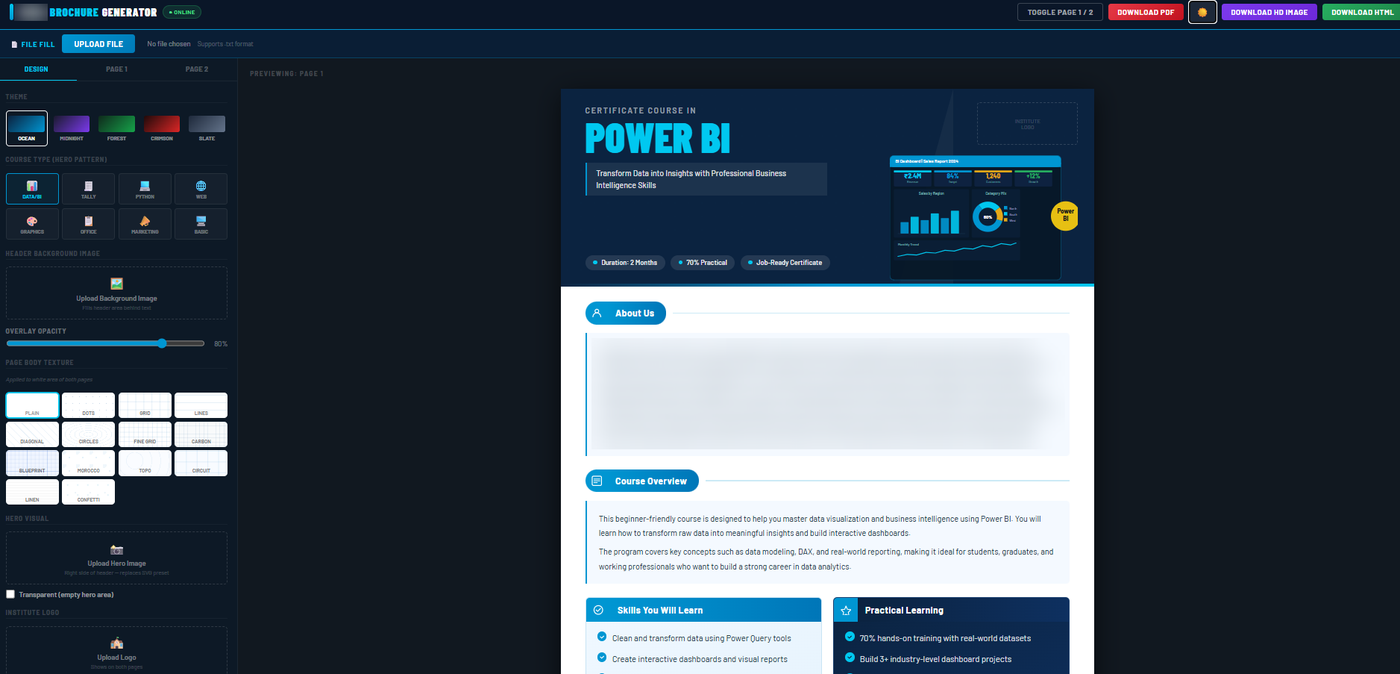
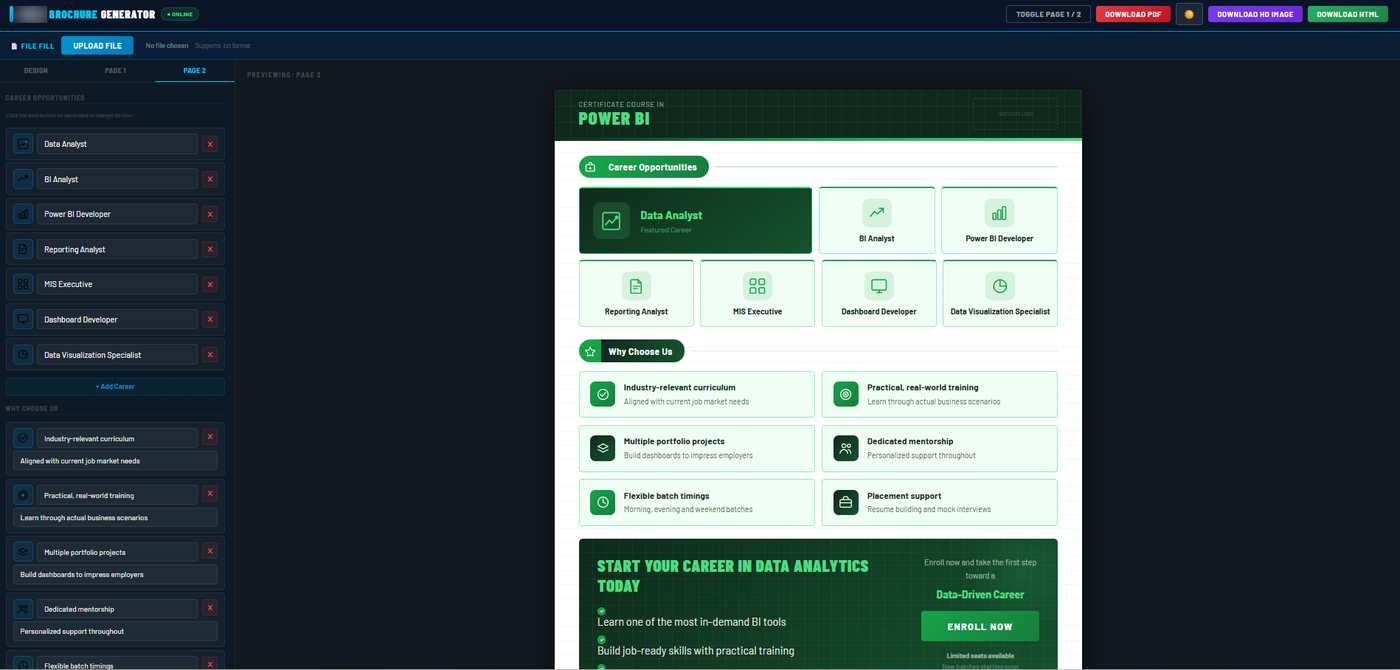
Computer institute | Custom brochure-design application |
Coaching centres | CRM, billing, report-generation systems |
The brochure app is my favourite example of what "custom" really means. A computer institute needed course brochures regularly. Instead of paying a designer every time, they now open a small application I built, select the courses they want to feature, and generate a finished brochure in one click — no design skill, no coding, no waiting. That entire application cost them ₹15,000. It solves one specific problem perfectly, which is something no off-the-shelf software was ever going to do for them.
Preschools are a world I know from the inside — I run preschool branches myself, and I've written in detail about what it really costs to start a preschool in India. That's also why preschool owners trust me with their software: I'm not guessing at their processes. If you run one and are weighing ready-made school software against a custom build, here's the two-question test I use.
Real projects, real prices
Here are actual projects with actual prices. All figures are from 2026, from my one-person practice — not metro agency rates.
Project | What it does | Price |
|---|---|---|
Construction CRM | Multi-user site reporting, phases, client follow-ups, quotations | ₹65,000 |
Clinic management system | Patient records, appointments, prescriptions, billing, reports | ₹52,000 |
Preschool website + data collection | Website with inquiry/data capture | ₹23,000 |
Brochure-design app | Select courses → one-click finished brochure | ₹15,000 |
Delivery time runs roughly 8 to 20 days per project. The honest reason for the range: I build alongside my other businesses. When I get long stretches of free time, projects finish fast; when other work eats my days, the same project stretches. The actual focused build time is far less than the calendar time. This very website — the one you're reading — went from nothing to fully live, with a complete custom admin panel, in about 3 days of building. I documented that entire process in the ₹2,999 website build-log.
The two problems almost every client has
After 11+ clients, the patterns are clear. Two problems come up again and again.
1. Owners don't know what digital can do for their business
This surprised me the most. The biggest barrier isn't price, and it isn't trust. It's awareness.
Most small business owners have been running some process manually for years — registers, Excel files, WhatsApp messages, memory. It works, more or less, so they never ask the question: "If a digital solution entered my business, what would it actually change?" They don't know what to ask for because they don't know what's possible.
Data sitting in Excel that nobody can search when they need it. Reports that take hours to assemble by hand. Follow-ups that live in someone's head. These aren't "software problems" in the owner's mind — they're just "how business is." Half my job is showing an owner what their own business looks like with those problems removed.
2. Report generation is broken everywhere
The single most common technical need: reports.
My favourite example is doctors in rural areas. After an operation, a doctor needs to prepare an operation summary — one copy for the patient, one for their own records, plus the patient's full history maintained somewhere. Many doctors do all of this by hand, for every patient, for years. They've never seen how simple record-keeping, summaries, and future follow-ups become with even a basic digital tool built around their exact workflow.
Whether it's a construction owner needing site reports or a doctor needing patient summaries, the shape of the problem is identical: information exists, but turning it into a usable report is manual, slow, and painful. Custom software kills exactly this pain.
My tool cost: about ₹5,000 a month
People assume building software requires a heavy setup. Here is my entire monthly spend in 2026:
AI coding tools + design software: roughly ₹5,000/month total. That's it. That's the whole stack on my side.
Everything else — hosting, database, domain — is set up in the client's own name, paid by the client directly. I deliberately keep it this way, and it matters more than it sounds:
The client owns their infrastructure. Their software isn't hostage to me.
There's no hidden markup on hosting bills.
My own costs stay low, which is exactly why my project prices can stay low.
₹5,000 a month is less than what many businesses spend on tea and printing. That's the real cost of a one-person software practice in 2026.
How I decide what to charge
My pricing comes down to three things: how complex the project is, how many features it needs, and how much of my time it will take. That's the whole formula.
But there's a deliberate philosophy underneath it. I keep prices in a range where a small business owner who is thinking about going digital can actually say yes. If custom software is only affordable for big companies, the businesses that need it most — the doctor writing summaries by hand, the institute paying for every brochure — stay stuck with manual processes forever. Keeping projects in the thousands instead of the lakhs isn't charity; it's the entire point. The margin works for me because my costs are ₹5,000 a month, not an office full of salaries.
What I can't do (the honest part)
Every "I built software with AI" story should answer this question, so here's my honest answer.
So far, every requirement that has come to me — including things I had never built before — I've been able to learn and deliver. I don't have a list of things I refuse to build. What I do have is an honest rule: if something new and genuinely challenging comes in, I say upfront that I'll need time for it, and then I try. Maybe some future project will finally hit a wall that learning can't break. It hasn't happened in these seven months.
What I won't pretend: I'm not an engineer, and I don't claim to be one. I'm an operator who has learned to get working software out of AI tools by understanding the business first. For the kind of software small Indian businesses need — CRMs, billing, reports, booking, internal tools — that has been enough, every single time.
My opinion: "custom software is expensive" is a myth
Here's the belief I've formed after 11+ projects, and I hold it strongly:
A custom digital solution for a small business is not expensive. It only looks expensive because owners have only ever seen agency pricing.
My real projects in 2026 ran from ₹15,000 to ₹65,000 — and those are complete, working, custom-built tools shaped around each business's exact process, not templates. An owner who assumed "software = lakhs" was never wrong about the quotes they'd get; they were wrong about what the software actually needs to cost. The economics changed in the last couple of years, and most business owners simply haven't heard the news yet.
If you take one thing from this article, take that: get your problem understood by someone before you accept that a solution is out of your budget.
If you're a non-coder who wants to build
Seven months ago I was where you might be right now: curious, non-technical, and slightly sceptical. Here's what my experience says actually matters:
Business understanding beats technical skill. My clients hired me because I understood their reporting problem, not because of my code. The AI handles the code.
Expect week one to fail. Mine did. Learning how to instruct and verify the tool is the real skill, and it's learnable.
Show, don't pitch. Small mockups won my first ₹65,000 project. Screens beat proposals.
Start with a problem you can see up close. My first project came from a business I was already observing. Yours might be your own business, a relative's shop, a friend's clinic.
If you want to see the process in full detail before trying it yourself, read the complete build-log of this website — 3 days, ₹2,999, every step documented. And I've published exactly what custom software costs in India (agency quotes vs what I charge). The full construction-CRM build-log is coming soon.
I'm a BCA dropout who failed his first week with AI tools. If the last seven months prove anything, it's that the door is open far wider than most people think.
