The 10 Questions Everyone Asks Me Before Opening a Preschool (And My Honest Answers)
Every year 15–20 people ask me about opening a preschool. Only 2–3 actually do it. I run 6 branches — here are my honest answers to the 10 questions I hear most, with real numbers.

Rahul Purohit
· updated · 10 min read
Every year, somewhere between 15 and 20 people ask me about opening a preschool. At the branch, on WhatsApp, at weddings — "ek baat puchni thi" (I wanted to ask you something). Out of those 15–20, maybe 2 or 3 actually open one.
I started my first preschool in 2022 in a small town in Pune district. Today we run 6 branches. So I have answered these questions many, many times — and I have also watched what happened to the people who asked them. This article is the face-to-face version of those conversations: the 10 questions I hear most, answered the way I actually answer them, with real numbers where I have them.
"Kitna paisa lagega?" — How much money will I need?
I spent ₹12 lakh in 2022, in a tier-3 town. I have broken down every rupee of that in a separate article: How Much It Really Costs to Start a Preschool in India. Read that before you make any budget.
But here is the thing almost everyone misses when they show me their budget: the first 6 months of staff salaries. People count furniture, deposit, interiors, curriculum — the things you buy once. They forget that from month one you are paying teachers, and fees take time to catch up. Your budget is not "setup cost". Your budget is setup cost plus the running cost of surviving until admissions stabilise. If your plan does not have 6 months of salaries sitting in it, your plan is incomplete.
And the question that follows this one — "kitne bachon se profit shuru hota hai?" — deserves its own article, so I wrote one: how many students a preschool needs to break even, with my year-by-year numbers and the formula you can copy.
"Ghar se chala sakte hain kya?" — Can I run it from my home?
Technically, yes — it can be done. But only if the setup is genuinely separate. That means a separate entrance for children and staff, completely apart from where the family lives and where family guests come and go. This is not about appearances. It is about security: if an outside guest is walking into the same space where 20 small children are sitting, child safety is compromised. Parents notice this, and they are right to.
And if you live in a joint family, with other small children in the house — then my answer is a flat no. Don't do it.
My honest opinion: even where it is possible, running a preschool from your home is not right for the long term — not for the business, and not for your own work. Treat home-based as a compromise you are consciously making, not as a clever way to save rent.
And if rent is what is pushing you towards home, there is a better answer than shrinking the business: make the rented floor earn more. Our preschool runs 9 to 1, but the same space also runs a daycare and activity classes after that — here's what the same floor earns after 1 pm.
"Registration kya kya lagta hai?" — What registrations and licenses do I need?
When I started in 2022, this is what I actually did: company registration, Shop Act (Shops & Establishment) license, and Udyam (MSME) registration.
Since then the rules in Maharashtra have changed. In April 2025 the state made it compulsory for private pre-primary institutions to register on its online Preschool Registration Portal, and a law is in the works that would add renewal every 3 years. All 6 of our branches are registered on the portal.
Two warnings. First, this is my Maharashtra experience — rules differ by state and they keep changing, so check your state's current requirement before you spend money on anything else. Second, don't let the paperwork scare you into inaction, and don't let the "koi nahi puchta" (nobody checks) crowd talk you into skipping it. Do it properly once. I will write a full article on the Maharashtra process separately.
"Yahan pehle se 3-4 preschool hain — chance hai kya?" — There are already preschools here. Do I stand a chance?
Wrong question. The real question is: what are those 3–4 preschools not giving parents?
One of my branches is in a Pune suburb where there were already 7 preschools nearby when we opened. Seven. We focused on the two things parents there were quietly unhappy about: child safety and hygiene. We started with 8 students. Two years later, that branch had around 40.
Competition is not the thing that kills preschools. An area with 4 preschools has proven demand — an area with zero preschools might have zero parents willing to pay. What kills you is opening as a copy of what already exists, with nothing a parent can point to and say "that's why I chose this one."
The mistake I watched happen: One person I know chose his location by looking at fees. His logic: "In my area, one student's fee is ₹30–35,000 a year. In this other area, schools charge ₹1–1.25 lakh per student. So I'll open there." Chasing that fee level, he invested far over budget on the setup. The losses that followed were big, and he had to shut down. The failure wasn't because he couldn't manage or wasn't capable — the over-budget start killed it before management ever mattered. When you start something new, your first job is to understand the process of that business. Revenue math comes after.
"Franchise loon ya khud ka kholun?" — Should I take a franchise or start my own?
I give out franchises myself, so you'd expect me to push you towards one. I won't. Here is how I actually put it to people:
Start your own only when you have extra money and extra time — enough of both that if some of it goes, it doesn't break you — and you are genuinely prepared to fall and learn. Your own preschool means you will make every mistake yourself, at your own cost. If that trade is affordable to you, it is also the deepest way to learn the business.
If you want to bypass that learning curve, then take a franchise — but only where trust is built. Before you sign anything, understand their complete way of working: what they actually do daily, how they handle admissions, staff, parents, everything. A franchise is worth its fee only when it transfers a working process to you, not just a name board.
"Mujhe teaching ka experience nahi hai — chalega?" — I have no teaching experience. Is that okay?
Yes — because you are not going to be the teacher. You are going to be the owner.
My own background: before 2022 I had worked in a computer institute, on the management side. So I had education-field experience, but zero experience teaching small children. When I started the preschool, I had to hire trained female teachers from day one — there was no other way, and there didn't need to be.
But there is one condition. You must know what good teaching looks like, so you can judge the person you're recruiting. You don't need to be able to run a classroom of 3-year-olds. You do need to be able to sit in an interview, or stand at a classroom door, and tell the difference between a teacher who is doing it right and one who isn't. That much, you have to learn.
"Teachers kahan se milengi? Salary kitni?" — Where do I find teachers, and what do they cost?
In a small town, teacher salaries run roughly ₹6,000 to ₹11,000 a month, depending on experience and role. Where they come from: referrals (the best source), local teacher-training centers, and trained housewives who want work that fits school hours.
Finding teachers is honestly not the hard part. Keeping them is. Staff churn is one of the biggest recurring problems in this business — I'll write about hiring and retention properly in a separate article, because it deserves more than a paragraph.
"Admission kaise aayenge?" — How will admissions come?
Here is how it actually works, at least in my branches: the phone rings first. Parents call, ask about fees and timings. The serious ones then walk in to see the place. The ads mostly exist to make that phone ring, and referrals mix into everything — a parent who came through an ad tells a neighbour, and the neighbour walks in directly. Because it's all interlinked, I honestly cannot give you a clean percentage split between walk-ins, ads, and referrals.
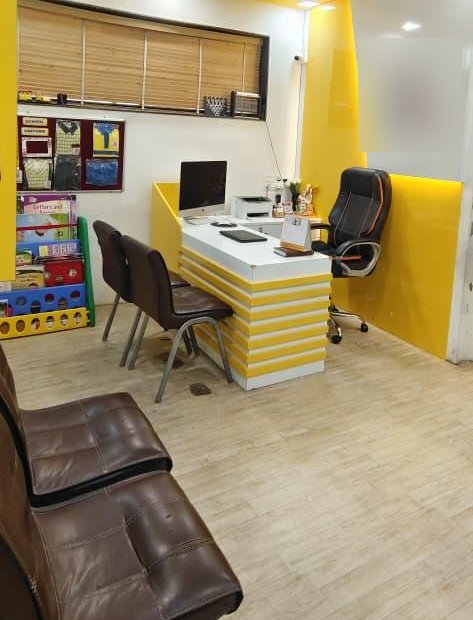
What I can tell you is this: the inquiry desk matters more than the ad. When a parent calls or walks in during season and someone answers properly, notes their details, and follows up — that is where the admission actually happens. An ad without a prepared inquiry desk behind it is money spent making a phone ring that nobody answers well. I've since written that out in full — the call script, the visit, the fee conversation and the follow-ups — in how a preschool inquiry becomes an admission.
"Main invest karunga, koi aur chalayega — chalega na?" — I'll invest, someone else will run it. Will that work?
This is usually a man asking, and my answer is usually the same: if you are investing, your wife sitting at the school is the best option you have. This is my strong opinion, and I'll defend it.
A preschool's front should be run by a woman. Parents of 2–4 year olds — especially mothers — connect with a woman at the desk in a way they simply don't with a man. She can build a positive, personal relationship with staff and with parents, and in this business those relationships are the business. Hiring an outside person and staying away yourself is the riskiest version of this model.
The first 2 years of a new preschool are the make-or-break period — that is exactly when an owner-family presence matters most. Even if you appoint someone professional to run operations, keep your wife there alongside them: she gets trained in the business, and supervision stays in the family's hands. An investor who is invisible for the first two years usually finds out too late what was actually happening at his school.
"Kitne mahine pehle taiyari shuru karun?" — How many months before opening should I start?
Work backwards from a June session start. Here is the calendar I tell people, and it means starting your research in September–October — a full 8–9 months earlier:
September–October: Research. Location survey — walk the area at school hours, see where parents actually go, understand what fees your area supports, and fix your total budget (including those 6 months of salaries from Question 1).
November–December: Finalise the space, negotiate rent and deposit, and start the registration paperwork.
January–February: Interiors, furniture, curriculum, and start hiring teachers.
March–April: Marketing activity begins — and your inquiry desk is ready and trained. This is when parents start calling for June admissions, and you must be ready to answer.
June: Session starts.
Most people compress this into 2–3 months and then wonder why the first year went badly. The setup can be rushed. The research and the inquiry season cannot.
What I've noticed after all these conversations
Of the 15–20 people who ask me these questions each year, the 2–3 who actually open a preschool are almost never the ones with the most money. They are the ones who asked Question 10 seriously — who treated this as a business with a process to learn, gave it the months it needs, and budgeted for the boring parts like salaries and follow-up calls.
If you're one of the people planning for June 2027: your September–October research window is right now. Start with the ₹12 lakh cost breakdown, and if you have a question that isn't in these 10, it might become question number 11 in a future update — the questions above came from real conversations, and the list keeps growing.
